
Dancing on the Wall
Climbing grades, monitor lizards, and finding Zen in climbing

Have you noticed that climbing is everywhere nowadays? If you do a Google for “climbing gyms”, you’ll probably find at least one gym in nearly every mid-sized city in America. The Bay Area has roughly twenty gyms. Japan alone has over 600.
But even though climbing gyms are new, people have been climbing for time immemorial. It’s ingrained in our culture, heritage, and history, and for some reason, even though we’re not nearly as good at it as our simian cousins, we seem to tie some of the highest achievements of the human race to climbing feats in particular. We climb Everest and Kilimanjaro, free solo El Capitan in Yosemite, and heck, some people even scale skyscrapers.
I remember one story my parents would tell me growing up:
In the 1600s, the Mughal empire had expanded deep into India and established strongholds as they spread throughout the continent. To counteract the Mughals, the Maratha king, Shivaji, had led a resistance and built an independent state, employing a strategy of obtaining key, hill forts through Maharashtra and Western India. These forts were strategically placed on tops of mountain peaks in the Deccan, and offered advantageous higher ground to scout for invading armies.

The Mughals had occupied a fort of particularly great importance, Sinhagad, that Shivaji needed to recapture for the Marathas. Shivaji enlisted the help of one of his bravest warriors, Tanaji Malusare, to scale the mountain and take the fort in the middle of the night like something out of a Tom Clancy novel. To climb the nearly vertical cliff face, Tanaji used his pet monitor lizard, Ghorpad, to whom he fastened a rope and had go up first. As the lizard climbed, Tanaji climbed on the rope with him, and helped set up rope ladders for the rest of his army. He and his army sneak attacked and battled the Mughals to successfully capture the fort, but Tanaji died in the fight. When Shivaji heard of his trusted friend’s death, he exclaimed “Gad ala, pan sinha gela” (We won the fort, but lost the lion).
You can’t make this stuff up1.
I imagine in our ancient history as a species, we used climbing as a necessary action; scaling trees offered us fruit and food we couldn’t otherwise reach. But in more modern history, climbing began to take off as recreation in the 20th century. In locales like Fontainebleau and Yosemite Valley, climbers were starting to reimagine the idea of expedition and exploration in climbing as a sport. And with the introduction of climbing as sport came objective measures, quantitative ways to compare achievements also known as grades. And that’s where we’ll start today, what grades have done for this sport and where we can go from there. But let’s first discuss the history of the current systems in place.
Yosemite Decimal System (YDS)
The first grading scale we’re going to talk about is one you’d run into in any gym with rope-climbing in the US, but probably not anywhere else in the world. If you’ve gone climbing before, you may be familiar with this style of grade, or at least have seen numbers that look like this:
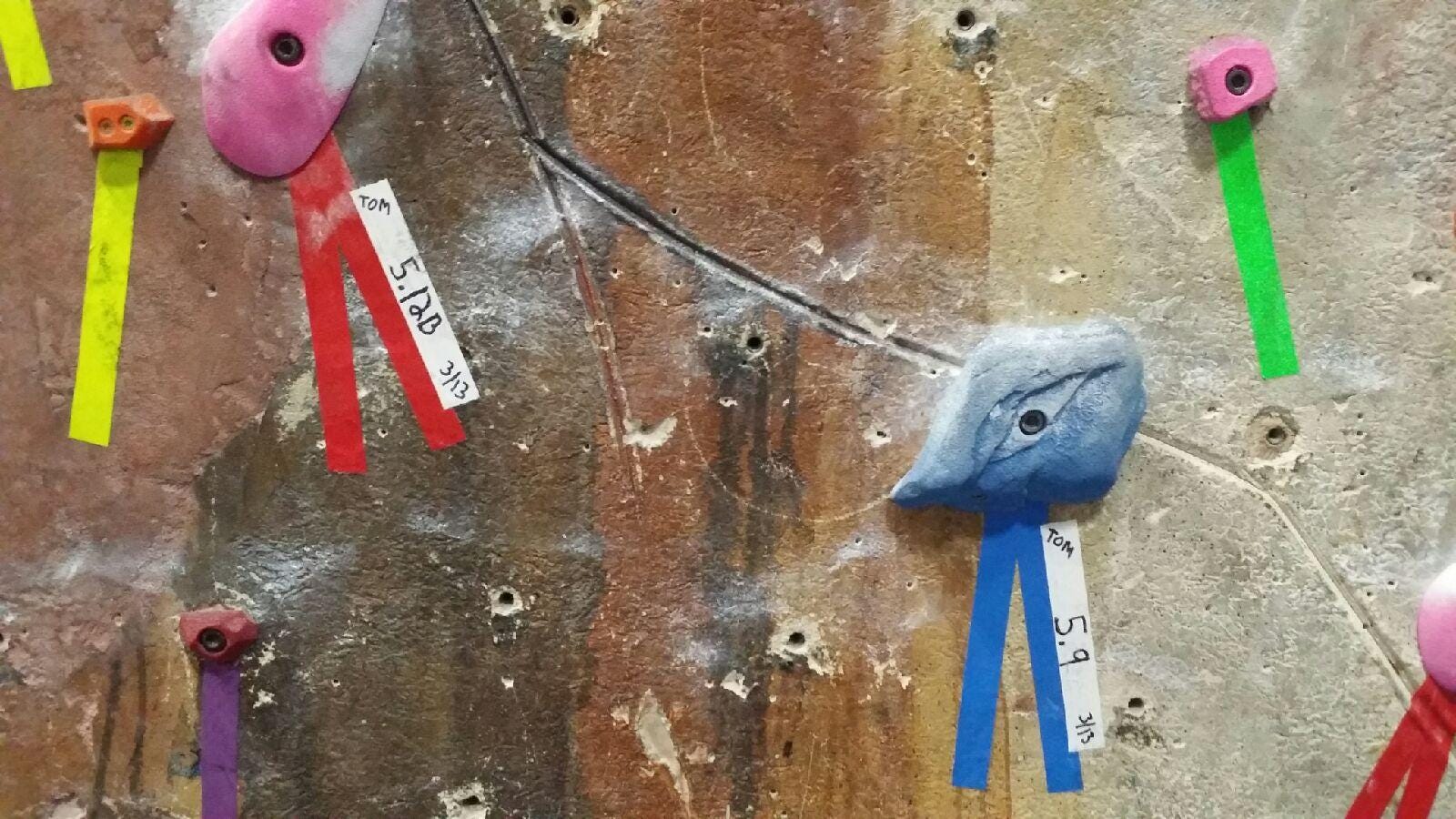
In a rock climbing gym, you’ll notice that every climb starts with a “5.” and some number afterwards, along with an additional letter sometimes?
To understand this better, I’ll refer interested readers to a detailed post here, but the key takeaway here is that in the 1950s the Sierra Club of North America wanted to establish safety ratings for hikes/treks on mountains. They broke these up into five main classes:
I: A classic trail hike. Not necessarily easy, but if you were to fall down it’s not particularly dangerous.
II: A slightly more strenuous hike with some usage of hands for placements. If you’ve been on a hike once in your life, you’ve probably done a class I or class II hike.
III/IV: These are called scrambles, and even though they’re not necessarily a lot more difficult, they’re certainly more dangerous than class I or II hikes. One bad foot placement could result in serious injury or even death. There are often sections of a class III or IV hike where using a rope is advised; not necessarily for climbing, but to act as a safety measure in case you fall.
V: These routes are not called “hikes” anymore, they’re just called climbs. A class V route requires ascending vertical terrain, and a fall can result in immediate injury or death. Note that this doesn’t necessarily mean a class 5 route is harder than a class IV or class III route, the classification is more based on the level of immediate danger if you mess up.
You might already notice a couple of issues with this framework. One big one is that we’re combining hikes and climbs into the same scale, which results in obvious issues (how do you “compare” the difficulty of a strenuous hike vs. an easy climb?). This is because the scale was built to try and capture the danger/risk of their hikes more than the difficulty of doing them. At the time too, there wasn’t nearly as much “difficult climbing” as exists today.
To address the difficulty question, the Sierra Club introduced a dot notation after the class of the 5 class routes. 5.2 routes would be strictly harder than 5.1 routes, and 5.3 routes would be even harder than 5.2 routes. The scale would end at 5.9, which they initially just labeled as “the hardest routes in the world”. But then something started to happen: climbers got better.
Because 5.9 was so open-ended and subjective, eventually the best climbers were able to cruise up many of these. To address this, they added 5.10 to the scale as well. Originally 5.11 and 5.12 were also added, but as more climbers climbed on these routes questions around discrepancies between grades started showing up more and more and so to help differentiate further, lettering was added for the “hard” climbs giving us grades like 5.12b and 5.13c. Currently the hardest rope climbs are graded at 5.15d, and only a few humans in the world can even think of holding onto the holds of, let alone climbing, these routes.
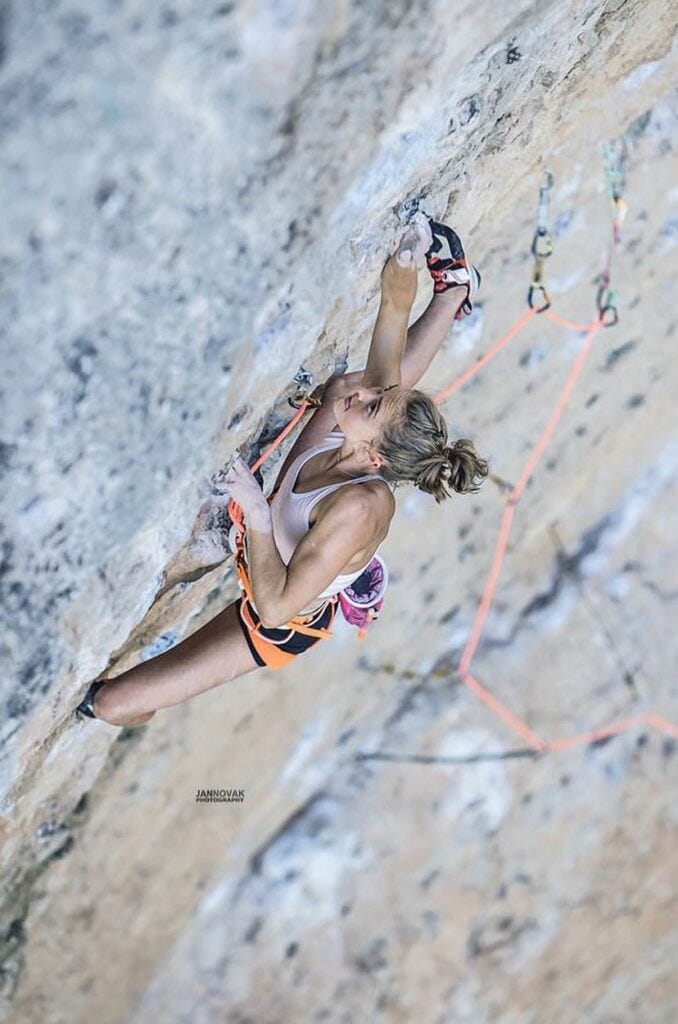
As climbing big walls began to explode in popularity, another sport started to take hold in Yosemite Valley. The unassisted climbing of smaller, shorter rocks: bouldering.
Bouldering and the V-Scale
Bouldering is just climbing without any ropes or aid other than maybe a pad to protect a ground fall. Although bouldering has probably existed since the stone age, its modern form owes its existence to John Gill2, who first brought ideas of gymnastics to the sport, along with the usage of chalk to keep the hands dry while climbing. Bouldering was first conceived as a training tool for climbing big wall routes in a safer way, i.e. providing a means of practicing hard sequences a few feet from the ground as opposed to thousands of feet in the air. Gill was a pioneer in helping evolve the understanding of bouldering to help it become a sport in and of itself alongside “big wall” climbing.
Instead of using the YDS scale to describe the difficulty of bouldering sequences, Gill created the “B” system:
B1: Moves that were as hard as the hardest climbs done on any roped climb. At the time this might have equated to a 5.10.
B2: Climbs with moves that were harder than anything in the B1 set.
B3: Climbs that only one (or no one) person had done. Once a B3 was repeated, it would become a B2 or even a B1.
The scale was perfectly minimalist and probably served as a means of using some short hand to talk about climbs, but the constant changing nature of the scale was probably not as useful as a means of achievement to many climbers, who were looking to get stronger and improve. Imagine if you went into a gym where the weights were just labeled “easy”, “harder”, and “something you probably can’t lift.”, but after someone really strong comes into the gym and lifts the heaviest weight, it gets “demoted” to “harder”?
As a way to measure difficulty more granularly, John “Vermin” Sherman invented the V-Scale in 1991. It just uses numbers (no letters), and starts with V0, and goes all the way up to (currently) V17. As of today there are roughly ten V17 boulders in the world, and no one climber has done all of them.
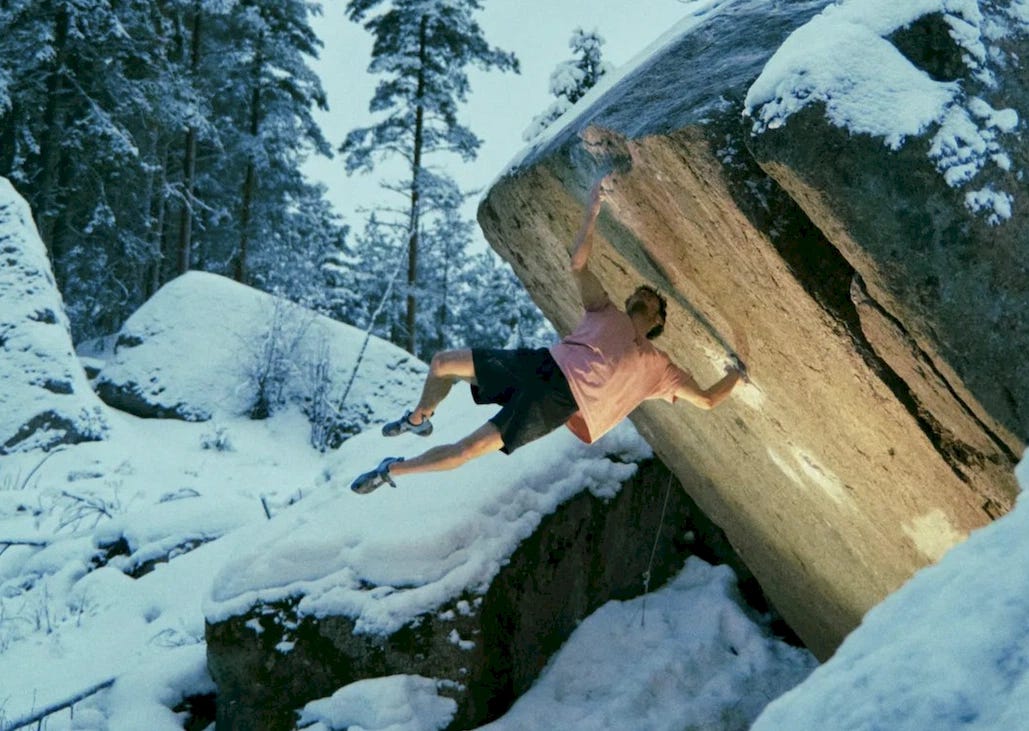
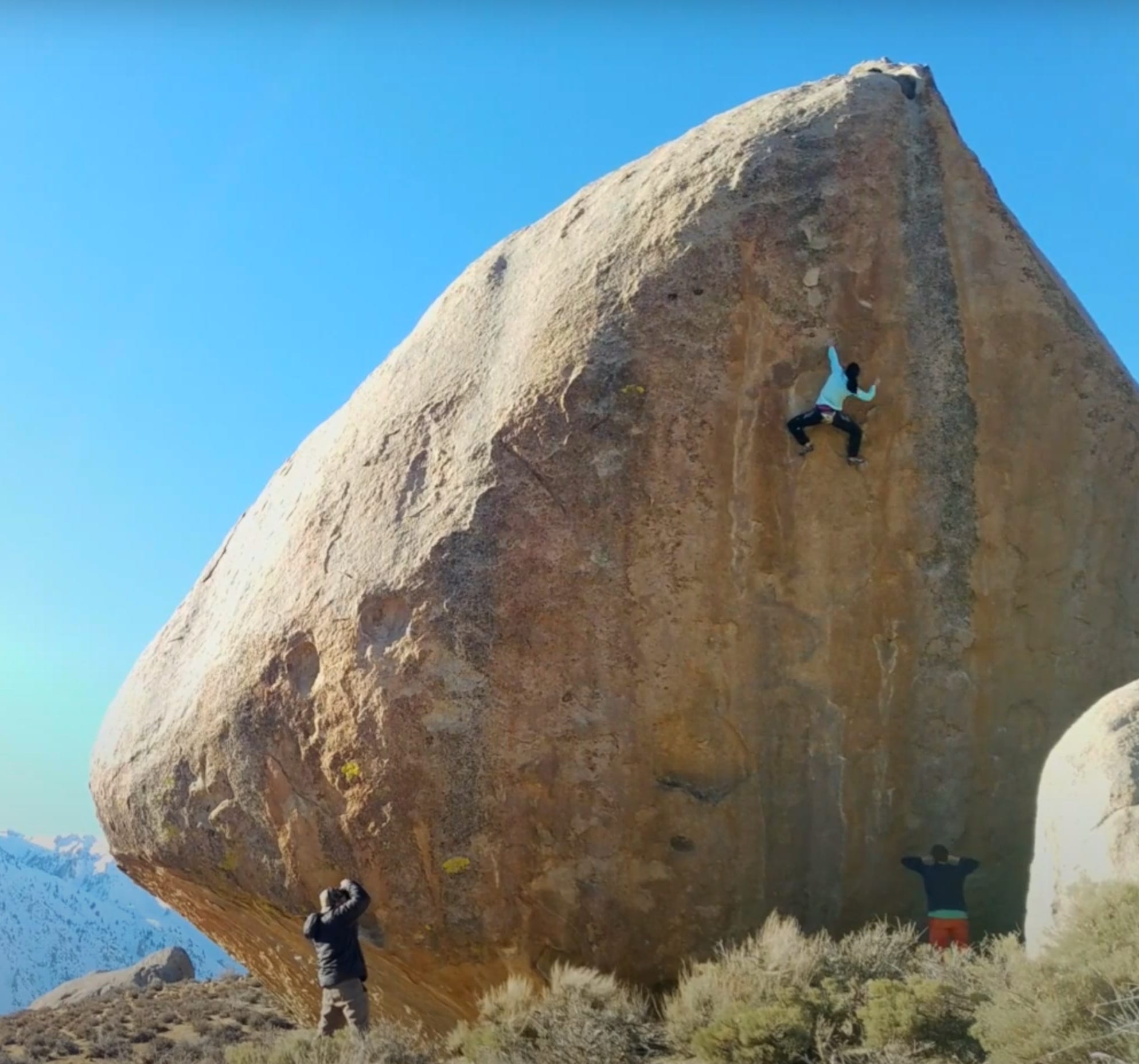
Each of these scales corresponds to the technical difficulty of the movements in a bouldering route, but not necessarily the safety of the moves made. For safety, there’s actually a completely different rating used for both YDS and the V-scale: G, PG, R, and X (borrowed from the MPAA guidelines). The rating describes the level of general danger you’re subjected to if you fall; For example, my local crag, Glen Canyon Park, has a ton of V0-X boulders. Easy to climb, but if you mess up your footing you have a very nasty fall awaiting you.
The Rise of Indoor Climbing
Outdoor climbing is an inherently seasonal sport. Rocks are especially sensitive to weather conditions, and a climb that feels impossible in the summer might go easily in the fall. As climbing became more sport-centric, indoor climbing began to rise in popularity as a means of training. And in the last 10-20 years especially, we’ve seen a huge rise in indoor climbing, especially indoor bouldering. In fact, many new climbers are introduced to climbing in gyms, but may never go outside and climb on actual rock. Unfortunately, with this new influx of climbers we’ve also seen a lot of toxic and gatekeeping behavior from the broader climbing community. Some refrains you’ve probably heard if you’re an avid gym climber:
“There’s no way that’s a V3. My gym grades way harder than this one.”
“The route setting here sucks. I just climbed that V5, but this V4 is impossible!!”
“I only use indoor climbing to train for my outdoor projects.”
One very common refrain we hear a lot as climbers in particular, is that “indoor grading is much easier than outdoor grading”. As much as we might like to avoid thinking about that, there’s some kernel of truth to this, and it’s worth diving into. Why does indoor climbing feel easier than outdoor climbing? Why might a V0 at a gym feel “easy” where a V0 outside may feel impossible?
I think the main reason is maybe less satisfying than you’d like, but to me the answer is pretty clear. It’s because outdoor and indoor bouldering are different sports.
The Birth of a New Sport
Let’s take a look at a classic outdoor boulder:
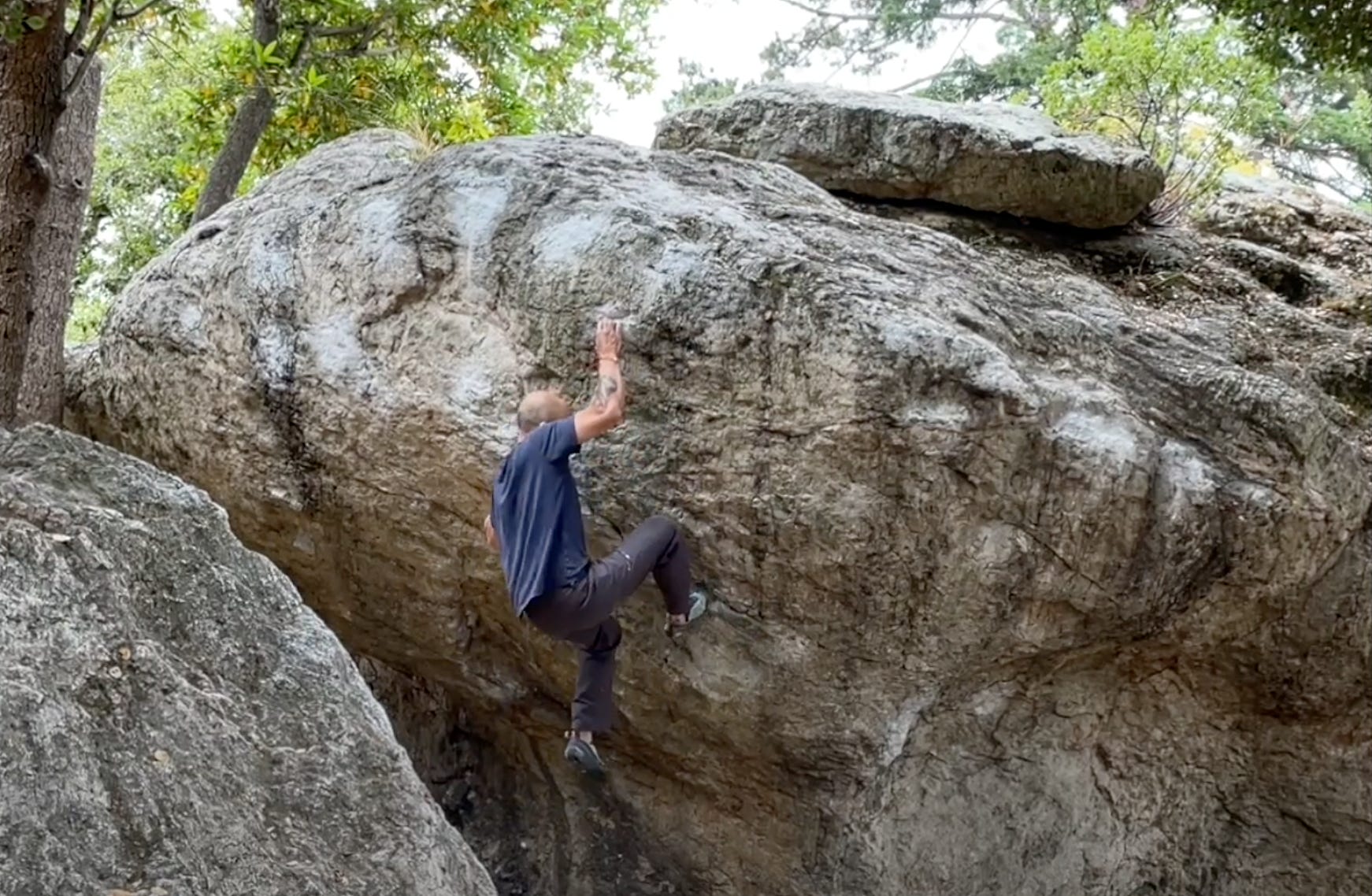
This is me sending an outdoor boulder in Berkeley. It took me nearly two years of practicing the moves and many sessions to finally get the climb, and it was really hard. It’s a classic outdoor route with small holds, one dynamic move, highly sensitive to weather conditions, and it’s in the middle of a neighborhood park to boot.
Now take a look at the following competition climb:
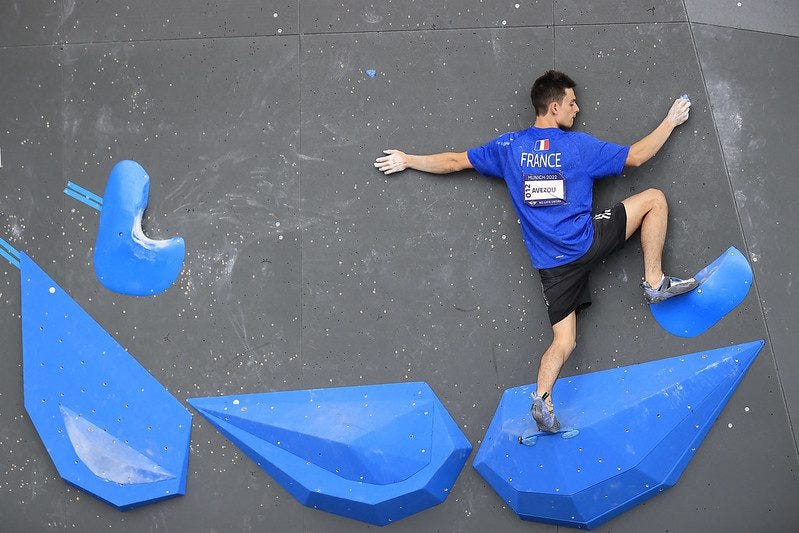
You can see some “rock inspired” hold shapes on the route, but the truth is that you will never see anything like this outside. Asking whether the climb is “harder than outside” is missing the point entirely because we’re witnessing the birth of an entirely new sport.
Gym grades emerged as a means of introducing new customers to climbing, without overwhelming them. Making V0s and V1s too challenging would turn away newcomers too early and keeping difficulty consistent across grades with reasonable ways to progress would ensure retainment. But even here, we run into inevitable issues with trying to assign numerical ratings or grades to climb because routes vary wildly in difficulty based on the kinds of technical moves they demand or the risks they require. Additionally, comparison to the outdoors continues to emerge anyway (should a V2 inside feel “as hard” as a V2 outside?). Indoor climbers and gyms have argued for various solutions to the problem:
Range grading: Instead of grading a climb exactly, let it fall into a range based on some consensus from the route setters. E.g. use ranges in the gym like V0-V2 or V1-V3. Gyms like Austin Bouldering Project utilize this to great effect, but in my experience it just creates a new grading system based around the range!
Crowdsource grading: This tries to replicate how grading is done on outdoor boulders; just let the climbers come up with the grade. For a little bit my home gym tried this tactic for their climbs; they would affix a sheet of paper and attached pen to each route, allowing climbers to “vote” on the grade of the climb. This was interesting to a degree, but eventually devolved into different distributions of climbers grading differently (i.e. morphological differences like height meant that a V5 for a taller climber could feel like a V6 for a shorter climber).
Gym System: Some gyms (like The Spot in Denver), offer their own system, unique to their gyms. After a while though, many climbers end up asking “What is roughly the V-grade equivalent of this 3 spot climb?” and it ends up being like an alternative form of currency rather than a transformation of the system.
No grades: This is one of those “fun in theory”, but “bad in practice” solutions. This just annoys climbers who want to know how they’re progressing, while allowing for a grading system to fill the void (i.e. climbers would just grade the climbs in their head anyway).
But before we throw up our hands and give up, we should talk about one more scale.
The Star Scale
In addition to YDS, V-grades, and safety scales, outdoor climbs generally feature one more rating that is entirely community driven: the average star rating, which generally follows a scale like this:
0 (💣): Avoid this climb at all costs. Maybe it feels contrived, doesn’t offer a fun experience in the least.
⭐ (Good): This is an average climb. Might offer some fun moves.
⭐⭐ (Great): Great climb, probably one of the best in the crag. Worth checking out if you’re there!
⭐⭐⭐ (Classic): This is one of the best climbs in the region. This is a must try climb if you’re nearby.
⭐⭐⭐⭐ (Mega Classic): This is one of the best climbs in the world. Climbers from all over come here to try this route.
Note that the star ratings are completely distinct from the difficulty of the climb. There are V0 Mega-Classics and 0 star V10s as well. For example, you would be remiss to visit Bishop and not climb the Iron Man V4 just because you’re a V10 climber.
I think the star scale captures something more authentic to a climb than its difficulty: a sort of indescribable quality that you can only really understand when you try climbing it. It’s the scale that makes you say “I don’t care how hard or easy the moves are, I have to get on that route!”
We’ve seen limitations emerge with each of the grading systems we’ve discussed. Each one tries to balance and work with multiple factors all at once: difficulty, safety, and fun. Inherently, these factors can’t all be captured in one number and more importantly, the number won’t be consistent for everyone. What might feel like one climber’s V3 could be another’s V5. What could feel like a terrible climb to one could feel like a classic to another. Worse, with the natural linearization of grading, we have a tendency to seek constant progression. There’s a certain kind of achievement-based dopamine hit we crave when we get to tick off a hard grade, and many climbers chase this feeling obsessively. But there’s ultimately a limitation to this progress because there will always be a limit to your rate of improvement. So where do we go from here?
Zen and the Art of Rock Climbing
When I first started bouldering, after a few months I could get up most V0s and V1s and occasionally a V2. One day, however, I was feeling particularly off and having a hard time getting up some easier climbs. I ended my session early and complained to my partner, Amulya, that I never wanted to climb ever again.
Me: I’m just going to quit my membership to the gym.
Amulya: Why are you upset by it?
Me: I’m just not able to climb as hard as I should be able to! I couldn’t even get up a V1 today!
Amulya: Is climbing itself not fun anymore?
Me: Well no, I still like climbing, but I’m just not improving as fast!
Amulya: So what if you’re not improving?
Me: Well what if I never climb a V2 again!
Amulya: Then you’ll never climb a V2 again right?
And something about her Socratic questioning clicked for me. I realized something then that I occasionally have to re-remember: One day you will climb your hardest climb.
It’s almost a tautology, reminiscent of a kind of a mathematical fact you might have learned in school, but it’s still true. Some day you will have climbed your hardest climb and that day could be behind you, or it could be ahead of you. You just don’t know. So what can you do with that information? You can approach it with a sense of grim Nihilism and decide that it’s not worth climbing at all because one day you will “stop improving”, but there might be another way.
When we climb solely to improve, in the singular pursuit of getting stronger and climbing harder, we open ourselves up to injury, forming bad habits, and losing the skill of finding contentment. In surfing there’s a kind of cliché that borders on cringe: The best surfer out there is the one having the most fun. But I wonder, could we not apply this adage to climbing too? What would climbing look like if we focused on our relationship to our bodies, the pursuit of movement, and exploring what feels genuinely exciting?
I remember the first climb I did in a gym that made me feel this way. It was a V2 that forced me to climb upside down, moving slowly, but precisely across the underside of a small roof, and over a lip to the top of the wall. I worked hard on this climb, conquering my fear of hanging upside down and breathing through tough moves. After I finally climbed it, my arms ached, my adrenaline was up, and I was 15 feet off the ground, but I knew it more intensely at that moment than ever: I would be climbing for the rest of my life.
How do we get back to this state of being? In my view we’re still missing one element from the puzzle. We can understand climbs from the perspectives of our many grading scales, but we’d still be missing a fundamental piece of the puzzle, you.
This is the principle of duality applied: The climb does not exist without you. When we try and objectively grade a climb, we’re trying to actively remove ourselves from the process for the sake of comparison. But fundamentally, a wall is only rock as you are only a person. The climb is both you and the wall working together to create it.
What this means then is that we can re-examine our relationship to climbing from one of domination or conquering (as we so often do with mountains) to one of trust and cooperation. Naturally then, it becomes a feat of exploration. Not just in terms of discovering what’s out there, but what’s in your inner self. What are you capable of achieving? What is really impossible or just possible for you? What can you do with the wall that you never imagined yourself being able to do?
Climbers put in days, months, even years of effort into perfecting every move on a climb, figuring out precisely each and every hand, finger, and toe placement. Finding small ways to reserve energy slightly more efficiently, utilizing their strengths, and exploring ways to move that they didn’t think possible. And in the process, they transform into new versions of themselves. They adapt to the wall and embrace their true selves so that they can experience the supreme bliss of pure, unadulterated movement. And after the dance ends, they’re so often left with a feeling of: “well, what else can we go climb now?”
So why do we climb at all?
We want to see what we can create.
We want to see what we are capable of.
We want to see who we really are.
If you’re looking to improve your relationship to climbing, please reach out to me. And if you’re looking for personal coaching with a like-minded person, I would highly recommend my coach and friend Nilo Batle if you’re in the Bay Area. He’s also interested in re-examining our relationship to climbing and movement and has been inspiring to work with.
If you visit Sinhagad outside of Pune, you can actually set up a top rope and climb some routes. Here’s the Mountain Project Page!
John Gill is one of the coolest people ever. In addition to being the Godfather of Bouldering he’s also an accomplished mathematician and has a research page!